Partnerships with athletic organizations is a mutually beneficial way for community banks to get their brands in front of large audiences while supporting the teams and athletes their customers and communities love.
Community Banks Win Big with Sports Sponsorships
Partnerships with athletic organizations is a mutually beneficial way for community banks to get their brands in front of large audiences while supporting the teams and athletes their customers and communities love.
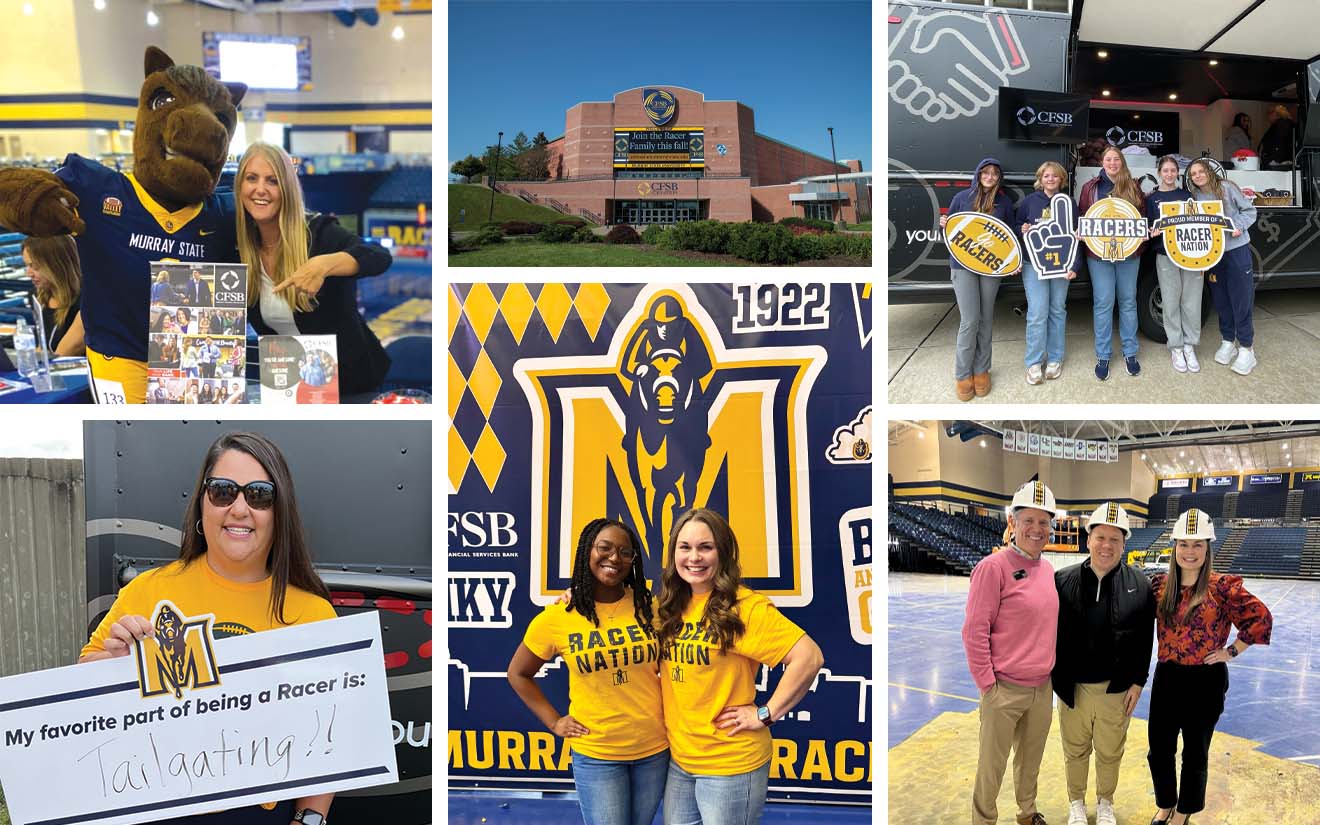
Clockwise from top left: Murray State University mascot Dunker and Community Financial Services Bank recruiter Heather Watkins at the MSU Career Fair; CFSB has lifetime naming rights to the school’s basketball arena; MSU students stop at CFSB’s marketing truck before a football game; (L-R) CFSB president Jason Jones, MSU vice president and director of athletics Nico Yantko, and CFSB vice president and director of marketing Dana Howard; (L-R) CFSB marketing intern Jada Poindexter and Howard; CFSB McCracken County market president Angela Meyer.
September 01, 2026 / By Taylor Hugo
Partnerships with athletic organizations is a mutually beneficial way for community banks to get their brands in front of large audiences while supporting the teams and athletes their customers and communities love.
The moment you arrive at Murray State University (MSU) in Murray, Kentucky, you can feel the presence of Community Financial Services Bank (CFSB). Its branding is everywhere, from live teller machines around campus to the classroom visits and financial literacy events it co-hosts with the school and student groups.
Perhaps most recognizable, however, is CFSB Center, home of MSU’s men’s and women’s basketball teams. In 2010, the community bank achieved lifetime naming rights to the stadium as part of a $3.3 million sponsorship deal.
“The university is such a lifestream of activity and tourism for western Kentucky. It really falls in line with the heart of what CFSB does as well,” says Dana Howard, CFSB’s vice president and director of marketing. “It’s a very ingrained partnership where we have the opportunity to impact all of campus, not just the athletics department, although obviously that’s the more public piece of it.”
Earlier this year, the $1.4 billion-asset community bank, which is based in Benton, Kentucky, reinforced its commitment to the school by signing on as Murray State Athletics’ first premier corporate sponsor and the first and only presenting sponsor of all women’s athletics in a five-year, six-figure deal.
“[We] really felt like this was the calling to set the tone for what community partners can do for the university and athletics program,” says Howard. “For us to have the opportunity to invest in all of those programs across the board, but also have that visibility at more sports, really ties into our heart and mission in what we want to do.”
CFSB is a prime example of how community banks can leverage partnerships with sports organizations to raise their profiles in the areas they serve while supporting the athletes and athletic programs their customers and communities care about. Whether partnering with a professional, collegiate or youth sports team, the benefits—such as brand awareness, facility improvements, athletic scholarships and financial literacy programming—make these sponsorships a slam dunk for all involved.
Aiding community bank brand awareness
For many community banks, the draw of athletic sponsorships is the exposure on a local, national or even international stage. Through jersey patches, stadium signage, co-branded ATMs and debit cards, TV and radio ads, or social media posts, being associated with a beloved local sports team can lead to significant benefits for community banks.
“It’s a great way to get our name out and drive brand awareness,” says Brooke Borrell, senior vice president of marketing, communications and partnerships for $15.13 billion-asset Bell Bank, the official bank for the Phoenix Suns, Phoenix Mercury and Valley Suns professional basketball teams in Arizona. “That has been a huge driver for us to help lower that barrier when our bankers or any of our team members are going out and having conversations, working with prospects or networking. To have people know who we are at a high level really helps us in everything that we’re trying to do.”
Even though Bell Bank, which is headquartered in Fargo, North Dakota, already had a presence in Arizona, this partnership—which started just over a year ago—was a way to reach new audiences through in-arena branding, community involvement and promotions for fans who open a new account with Bell Bank.
“The way that we approach our partnerships and finding the right opportunities is really through building relationships and finding groups that we align with on our core values,” says Borrell. “It was the most natural fit. It was a fantastic alignment at every single level between our teams, our approach to business and operations, and how we could showcase that partnership in the community.”
An eye on organic growth through sponsorships
Frost Bank in San Antonio, Texas, has also found value in using athletic sponsorships to make a splash in specific markets and fuel organic growth. When the $52.7 billion-asset community bank—a sponsor of the NBA’s San Antonio Spurs since 1973—was expanding in the Houston, Austin and Dallas-Fort Worth areas, it looked for athletic teams it could partner with to build brand awareness and tell the story of its roots in those communities. As a result, Frost Bank now sponsors the NBA’s Houston Rockets, Major League Soccer’s Austin FC and the MLB’s Texas Rangers.
“We’re an organic growth financial institution,” says Jimmy Stead, Frost Bank’s chief consumer banking officer. “A lot of what we’re doing in marketing is to support that organic growth and that organic expansion. The partnerships that we formed are really a key part of that.”
Stead mentions some highlights of the partnership, such as naming rights for the Spurs’ arena, the Frost Center; a co-branded debit card that nets cardholders perks like early entrance to the arena and discounts on tickets and merchandise; and being the first-ever jersey patch sponsor for the Spurs.
Tips for a successful community bank sports sponsorship
If your community bank is considering a sponsorship with a sports team or athlete, these tips can help get you started.
- Build relationships with the people who execute athletic experiences every day, such as the athletic department of your local university. “They know what it takes to create a partnership that works and benefits both of you,” says Dana Howard, director of marketing for Community Financial Services Bank in Benton, Kentucky.
- Be thoughtful about how the athletic organization fits within your community bank. “The partnerships are so easy to bring to life when you align at all levels of your organization and across all of your values,” says Brooke Borrell, senior vice president of marketing, communications and partnerships for Bell Bank in Fargo, North Dakota. “It translates to authentically being able to engage with those audiences and the fan base.”
- Clearly lay out the terms of the partnership, says Jennifer Spence, director of marketing for Banterra Bank in Marion, Illinois. Banterra starts each Name, Image and Likeness (NIL) partnership with Southern Illinois University with a kickoff dinner between the athletes, bank executives, Saluki Sports Properties and the university’s athletics department to outline expectations.
- Don’t disappear after cutting a check. Be present and attend games of the teams your bank financially supports. “Pay attention to what’s going on, so you can come up with ideas and be a good partner,” says Howard.
Sports sponsorships can boost community bank market share
The brand awareness from these athletic partnerships is showing up in tangible ways for other community banks, too. Banterra Bank in Marion, Illinois, has had a relationship with Southern Illinois University – Carbondale (SIU) for seven years, including naming rights for the Banterra Center, and has a separate agreement to serve as the official bank of the SIU Alumni Association. In that time, the $3.3 billion-asset community bank has seen an increase in market share from 16% to 24%.
Bank president and CEO Jeff May says two key growth drivers for the bank are responsible for thousands of new account openings: the airtime Banterra receives during school sporting events and initiatives like its co-branded Banterra-SIU Saluki debit card.
Even when the financial return from a sports sponsorship is harder to track, May says the exposure is worth the investment.
“Marketing is not an easy thing to measure the value of,” he says. “You have loyalty to the entire footprint this university or college is involved in. You get the benefit of that loyalty, and you get to share the branding and your footprint, so you’re going to get growth from it. Don’t look at it as sponsorship. You really have to look at it as advertising and promoting the brand.”
Supporting local teams and athletes
Athletic organizations and individual athletes also reap the benefits of these partnerships with community banks. Another piece of Banterra Bank’s partnership with SIU is its Name, Image and Likeness (NIL) program, in which four student athletes are selected every year as brand ambassadors for the community bank. In exchange for the athletes participating in TV, radio, social media, outdoor and print promotional materials and opportunities, Banterra provides a portion of transaction revenue from its co-branded debit card to support SIU scholarships and NIL efforts.
Jennifer Spence, director of marketing for Banterra Bank, says she relies on recommendations from Saluki Sports Properties, the locally based Learfield team for SIU, and the SIU athletics department to select up to four NIL athletes each year. She notes they take into consideration the athletes’ hometowns—they strive for athletes to be from the bank’s six-state footprint—and how much play time or exposure they’re expected to get.
“From a branding standpoint, the value piece for me is the social media coming from the athlete,” says Spence.
On a broader scale, community bank sponsorships can be used to improve athletic facilities, benefiting both the teams and the community. When MSU broke ground on an eight-figure renovation of CFSB Center earlier this year, CFSB committed $2 million to build the CFSB Center Courtside Club, a bunker-style space where MSU Racer fans can experience the game right next to the action on the court.
“It’s been such an important part of what we do in the community to be a partner with the university, because it is a piece of our region that is unique to us,” says Howard. “Also, from the visibility standpoint, there are not a lot of other places in this region that you’ll have the gathering of community members like you do at the university, so it can impact your visibility so much, just having that partnership there.”
Athletic sponsorships also shine a spotlight on the teams and athletes that might not have the resources that bigger organizations do. Being able to enhance the visibility of women’s sports was an important factor in CFSB’s recent deal to become the presenting sponsor of all women’s athletics at MSU. This includes the continuation of the women’s basketball free-attendance model, in which CFSB covers the cost of all women’s basketball home game tickets, allowing everyone in the community to enjoy the games for free.
“We are a leadership team that is made up of a lot of females,” says Howard of why supporting women athletes and leadership is an important initiative for CFSB. “It’s a time to be a part of women’s sports. If there’s any way we can help promote them, we want to do it. We want to show them they’re supported but also show the community that they’re a big deal and we’re behind them all the way.”
Local sports sponsorships pay dividends
Communities also benefit when community banks and sports teams partner up, often delivering special events, investing in important causes and increasing financial literacy in the areas both organizations serve.
One Community Bank in Oregon, Wisconsin, is often approached by local sports teams to be a sponsor.
“OCB is an organization that speaks frequently and proudly about our mission statement. It’s not just on a bulletin board in the break room,” says Jeff Versluys, executive vice president and chief strategy officer for $2.6 billion-asset One Community Bank. “All of our colleagues know that the mission is to serve clients, support colleagues and invest in our communities. We take that ‘invest in our communities’ component to heart.”
When One Community Bank expanded with a new location in Cottage Grove, Wisconsin, in 2024, it recognized an opportunity to build brand awareness in the area by sponsoring the boys’ and girls’ youth soccer club, Monona Grove FC. The community bank’s financial commitment helps purchase team jerseys, which are emblazoned with One Community Bank’s logo.
“It helps keep the cost down for families participating in those activities,” says Versluys. “Not all families can afford to pay for a new jersey. That’s the feel-good part of it for us, knowing that we’re helping families be able to get their kids on the field.”
Community impact is a piece of every partnership Frost Bank enters. Earlier this year, it was designated as the official financial literacy partner of the Texas Rangers. The initiative provides financial literacy education to Texas families and a $10,000 scholarship to one Rangers Youth Academy participant. Additionally, Frost Bank joins forces with the nonprofit arm of the San Antonio Spurs, Spurs Give, to award grants to improve infrastructure and facilities for youth organizations.
“Something that’s been important for us is longevity and continuity,” says Stead. “There are a lot of opportunities that come across that are one-time deals. That hasn’t been as important to us as forming a real relationship with an organization where we’re going to grow together over time and be successful together over time.”
Bell Bank sees the most engagement from its partnership with the Phoenix Suns and Phoenix Mercury when working on an initiative with community involvement. When Bell Bank became the official banking partner of the Arizona basketball teams in 2025, it brought its Pay It Forward program to the teams. Every year, Bell Bank employees receive funds to give as they choose to individuals, families and organizations in need.
It works with the Suns and Mercury to identify causes the players are passionate about and then plan site visits or volunteer opportunities with players and bank team members at those organizations, says Borrell. “It’s been incredible to see the impact and build those relationships further in the Phoenix community.”
What is included in a community bank–athletic organization sponsorship?
Partnerships with athletic organizations can be customized to meet the specific needs and goals of your community bank. A sponsorship might include:
- Signage and naming rights for arenas, practice facilities, tournaments, or premium seating sections or lounges
- Name, Image and Likeness (NIL) agreements, in which athletes are compensated in exchange for endorsements and appearances for your community bank
- Co-branded debit cards that offer team-specific rewards for account holders
- Bank branding on jerseys or other merchandise sold at games
- Ticket perks, such as discounts, early access to games and designated seating sections
- Branded ATMs placed throughout a team’s facilities
- Co-branded community programming, including financial literacy events, nonprofit donations and volunteer opportunities
Taylor Hugo is a writer in Colorado.
Subscribe now
Sign up for the Independent Banker newsletter to receive twice-monthly emails about new issues and must-read content you might have missed.
Sponsored Content

Featured Webinars


Join ICBA Community
Interested in discussing this and other topics? Network with and learn from your peers with the app designed for community bankers.
Related Articles

How Community Banks Can Navigate Today's Risk Landscape
CybersecurityCompliance & Risk

ICBA's Impact on the 21st Century ROAD to Housing Act
AdvocacyLegislation and Regulation

Portfolio Management: What the Bond Yield Curve Mean Reversion Means for Banks
GrowthInvestment and Insurance
Subscribe Today
Sign up for Independent Banker eNews to receive twice-monthly emails that alert you when a new issue drops and highlight must-read content you might have missed.
News Watch Today

Join the Conversation with ICBA Community
ICBA Community is an online platform led by community bankers to foster connections, collaborations, and discussions on industry news, best practices, and regulations, while promoting networking, mentorship, and member feedback to guide future initiatives.
Join the Community Example Text