Community banks might feel compelled to expand to keep up with the competition by adding branches. But many banks have found long-term success operating out of a single location. Hear from four community banks on why staying small has improved their business and deepened their connection with customers.
Staying Small and Thriving: How 4 Community Banks Succeed With Only One Location
Community banks might feel compelled to expand to keep up with the competition by adding branches. But many banks have found long-term success operating out of a single location. Hear from four community banks on why staying small has improved their business and deepened their connection with customers.
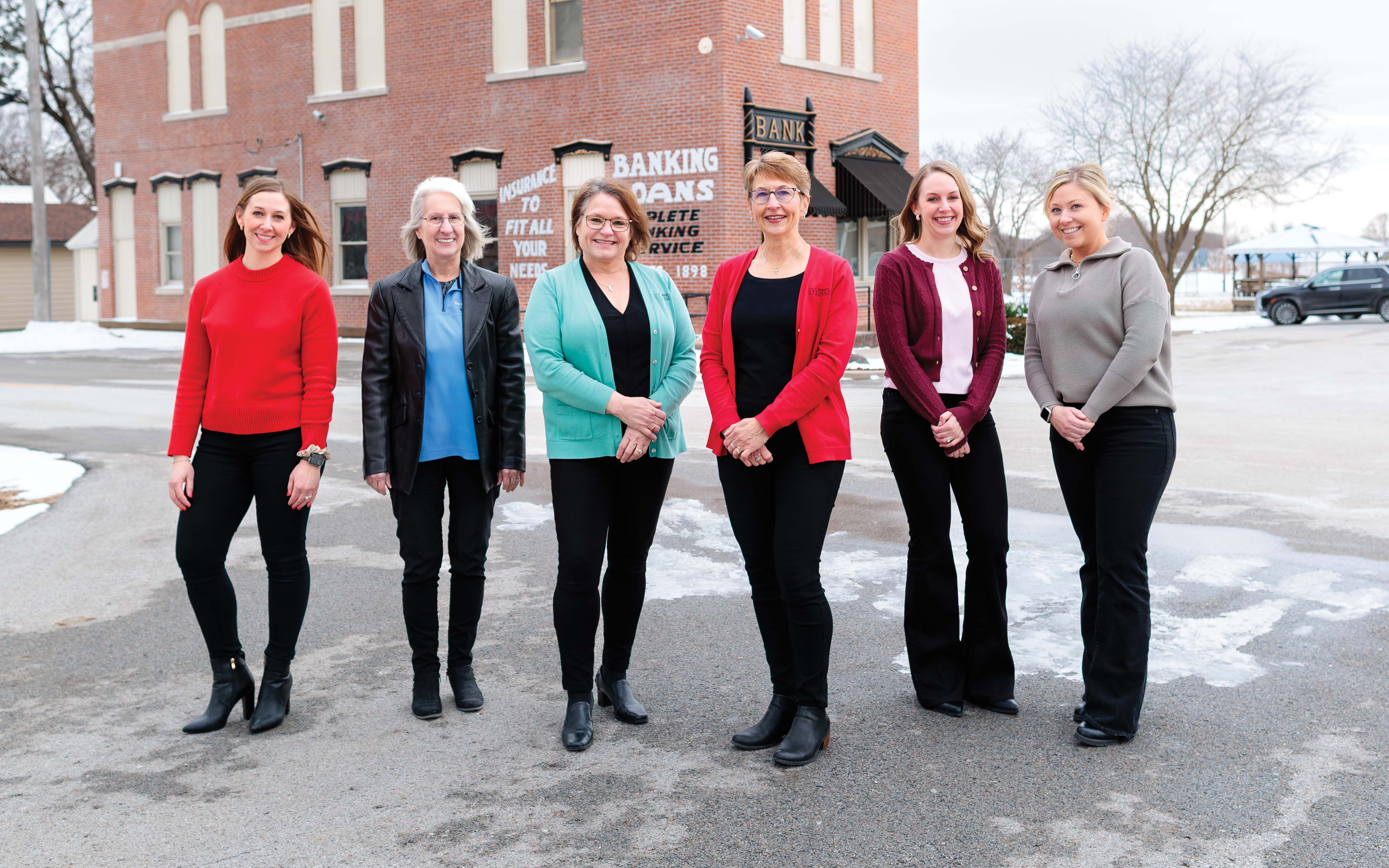
The Bank of Steinauer in Steinauer, Nebraska, is happy with one location. The bank’s entire staff, from left: Megan Sudik, compliance coordinator; Kathy Johnson, VP of operations; Suzanne Borcher, president; Carol Schaardt, vice president; Taylor Fink, compliance officer; Brittany Freeman, teller/customer service
March 01, 2026 / By William Atkinson
Community banks might feel compelled to expand to keep up with the competition by adding branches. But many banks have found long-term success operating out of a single location. Hear from four community banks on why staying small has improved their business and deepened their connection with customers.
Are there benefits to a community bank and its customers by just having one location? Chris Coufal, president of Carmine State Bank, wholeheartedly agrees that there are.
“We often say, ‘We may have no branches, but we have deep roots,’” he says.
While community banks in cities and other larger communities might feel compelled to keep growing to compete with other financial institutions, those in smaller towns can often do quite well with just one location. With a single location, overhead is lower and operating costs are smaller, to name just two reasons. Close customer relationships is another.
Here, we look at four community banks—three of which have been in business for over 100 years—that have found success with one location.
Bank of Steinauer: Small-Town Banking With One Branch
Since 1898, the Bank of Steinauer has operated out of one location in Steinauer, Nebraska. According to Suzanne Borcher, president of the $24.5 million-asset institution, the single-branch strategy serves the bank well in terms of meeting the needs of its community and customers.
“Since decisions are made in-house and we know our community, we can respond quickly to loan requests, seasonal agricultural needs and unexpected challenges,” Borcher says. “Customers know they can walk into our bank and immediately talk to someone who can help.”
The community bank focuses a lot of attention on attracting new customers. In rural communities, says Borcher, nothing is more powerful than personal recommendation. “Our reputation for honesty, speed and personal service are our strongest marketing tools,” she says. “Also, we are accessible and out in the community volunteering, being on many committees, attending events, and supporting local organizations and businesses. This has helped our bank create connections and foster relationships that naturally grow into long-term banking partnerships.”
The Bank of Steinauer finds having just one location to be the best way to operate. “Without the burden of multiple branches, we invest more in customer care and staff training,” says Borcher. “Because all our decision-makers are under one roof, our customers get answers quickly, which is especially important for agricultural and home lending. With six employees, we know every customer, and every customer knows us.”
Since the community bank is small and locally focused, when a customer walks through the door, staff doesn’t just look at the numbers. “We care about helping the people behind the numbers,” Borcher says. “For example, we know who has had a baby, whose kid plays in the state tournament and whose mother is ill. We truly know our customers.”
This way of doing business is something the Bank of Steinauer plans to maintain. “We have considered expanding, but it raises questions about how expansion might change who we are,” she says. “One of the things we value most is working together as a family. A second branch would mean splitting up leadership, something that has never felt right. For us, it’s not about how many branches we have. It is about doing exceptional work for the community we serve.”
Carmine State Bank: 120 Years as a Single-Branch Community Bank
“Our bank has always had one location since opening in 1907,” says Chris Coufal, president of $150 million-asset Carmine State Bank in Carmine, Texas. Carmine is a small town, population 254, located halfway between Houston and Austin.
The community bank has true staying power: It was the 269th charter to be approved by the Texas Department of Banking. Today, “we are the 10th oldest state bank in Texas,” Coufal says.
There’s no majority owner of the bank. Many of the shareholders received their stock from previous generations, as it is passed down from one generation to the next. “For some of our shareholders, their ancestors were initial stockholders when the bank was organized in 1907,” says Coufal.
Carmine State Bank has been run by two families since 1907. From 1907 to 1984, the Doerr family ran the bank, with a father-son team. Today, another father-son team is in charge. Calvin Coufal, Coufal’s father, joined the bank in 1977 and serves as chairman and CEO. And recently, Coufal’s daughter joined the bank as a teller.
“With a small, close team of bankers running the bank, we consider each other like family, and we treat our customers like family, also,” says Coufal.
Carmine State Bank has identified a few strategies it has found effective in meeting the needs of its community and customers with a single branch. “We take local deposits and lend them out back into our local community,” Coufal says. “We also support the communities we serve. We support the local chamber of commerce, fire department, churches and school fundraisers.” He adds that it’s common to find the community bank’s staff working at many of these events.
If customers have a compliment, complaint or even just want to discuss the weather or cattle market, they can come in and visit with Coufal or his father. “Our office doors are always open, no appointments needed,” he says.
Another advantage Carmine State Bank believes it has over larger institutions is its faster and more flexible decision-making, whether a customer is opening a deposit account or applying for a loan.
“We know our customers and are able to assist them, whereas large, multilocation banks may not be able to,” says Coufal. “With our lean operational footprint, we can sometimes be more competitive on fees and rates when compared to larger banks.”
Coufal notes that a number of banks in State Bank of Carmine’s area have been acquired by larger financial institutions recently, which creates opportunities for the community bank.
“Most new customers are attracted to us because we are local,” Coufal says. “They like our uniqueness, being a small bank with no branches. Customers are attracted to us because we are hometown, operate conservatively and know them by name. Our customers are more than just account numbers.”
If a customer has a question or issue, they can call the bank or come into the lobby. “We will not instruct them to call an out-of-state or out-of-town call center,” says Coufal. “We take care of them right here.”
He says there are several benefits to having just a single branch. One is efficiency. With each location, he notes, there are additional operating costs like more equipment, property taxes, maintenance and additional staffing. “We can run our bank very lean with one location,” he says. “Our staff are all cross-trained and very knowledgeable across multiple bank departments. In fact, this also served us very well during the pandemic, by having everyone cross-trained in multiple areas.”
In terms of considering a second location, Carmine State Bank has found no reason to do so. “We often say, ‘We may have no branches, but we have deep roots,’” says Coufal.
“With today’s technology of remote deposit capture, mobile check deposit and e-signing, customers can bank from their home or workplace, in another town or state,” he says. “We have stable, loyal customers, and existing deposits are more than adequate to fund our loan growth. We believe in lending locally while supporting our community and customers. Being locally owned and operated has served the bank, stockholders, customers and community very well over the years.”
Anchor State Bank: A deep focus on ag lending
From its founding in 1895 to today, $66 million-asset Anchor State Bank and its staff have had their roots firmly planted in the village of Anchor, a base for serving the communities and agricultural areas of central Illinois, says Chris Crider, president and CEO. When it opened more than 130 years ago, the bank was officially known as “The Anchor Bank” until it received a state charter as Anchor State Bank in 1920.
In July 1951, the bank opened a savings department for the first time, with a savings account paying 1% interest. In April 1982, the bank opened a new trust department, and in 1999, the bank’s building was completely remodeled. And, in a continuing effort to provide the best service possible, the bank purchased and renovated an adjoining building in 2022.
“We have looked at servicing customers through a multifold approach,” says Crider. “First and most obvious is our physical presence, with several of our customers being within 25 minutes of the branch.
“Second, when I came on board almost six years ago, we added technology in the way of online and mobile banking. This has been successful for our customers who are, obviously, over 25 minutes away.” This customer group has grown significantly, according to Crider.
As a smaller bank, Anchor State Bank can offer personalized services. “Many times, we go and physically meet with customers at their homes, businesses or somewhere in between,” Crider says. He says he also sees many of the bank’s customers out and about, because they eat at the same places or are involved in the same groups.
Another attraction is the staff’s agricultural knowledge, which helps attract new customers to the bank. “Both myself and our other ag lender farm personally and raise livestock,” Crider says. “We can relate and connect with our customers on all levels.”
Timing of delivery has also been a big factor in the bank’s success. “Oftentimes, I can make a decision on a loan in a day or less, when competition takes days to make a decision,” he says. “Finally, our personal touch, where we take ownership with every customer no matter their size, sets us apart. This personal touch allows us to get to know our customers on a deep level and help them solve their needs better.”
Anchor State Bank is happy with having a single location. “From a bank perspective, having a single location makes business simpler,” says Crider. “All of our people and information can be reached at the same time in one place. When something in business changes, we can respond quickly, because our team is one place and communication is easy.”
The future? “We will be opening a loan production office in 2026,” he says. “However, this was decided more from a disaster recovery and business continuity priority, rather than growth.”
American National Bank Fox Cities: Personalized business banking
739
U.S. banks had just one location in 2025. That’s about 16% of the country’s 4,379 banks.
Source: usbanklocations.com; FDIC
American National Bank Fox Cities was founded in 1993 with a focus on serving the financial needs of local businesses, according to Paul Northway, president and CEO of the $420 million-asset community bank.
“We have maintained our model of one full-service branch in Appleton, Wisconsin,” he says. Over the past eight years, though, the bank has also established a standalone loan production office in Green Bay, about 30 minutes north of Appleton.
“Our success has been built on strong relationships through bankers who are curious and take the time to truly listen to our clients and deliver financial solutions with a sense of urgency,” says Northway. “Our responsiveness sets us apart from the competition.”
To attract new customers, American National Bank Fox Cities relies mostly on word of mouth. “Word of mouth has certainly been the key to new relationships,” he says. “Our clients are our best source of referrals.”
The lower overhead required by only having one branch is certainly a benefit, according to Northway. “Our overhead as a percentage of assets is about 70 basis points below that of our peer group,” he says.
Has there been talk of opening a second branch?
“We have continued to grow with this model,” says Northway. “It would be short-sighted to not consider a second branch. If we did, I believe the impetus would be the opportunity to gain new relationships and strengthen our core deposit base in a community that is near our headquarters.
“Any new market entry would be all about the people,” he adds, “[and] having the right banking team that is firmly established in the community.”
William Atkinson is a writer in Illinois.
Subscribe now
Sign up for the Independent Banker newsletter to receive twice-monthly emails about new issues and must-read content you might have missed.
Sponsored Content


Featured Webinars


Join ICBA Community
Interested in discussing this and other topics? Network with and learn from your peers with the app designed for community bankers.
Related Articles

Something’s Feasting on Your Tech Budget. The Playbook Starves It.
GrowthRevenue and Expenses

40 Under 40: 2026's Community Bank Leaders
CulturePeople

The Lending Outlook and Loan Growth Trends for Community Banks in 2026
Ag LendingLending

How Can Community Banks Best Manage Change?
GrowthLeadership and Succession
Subscribe Today
Sign up for Independent Banker eNews to receive twice-monthly emails that alert you when a new issue drops and highlight must-read content you might have missed.
News Watch Today

Join the Conversation with ICBA Community
ICBA Community is an online platform led by community bankers to foster connections, collaborations, and discussions on industry news, best practices, and regulations, while promoting networking, mentorship, and member feedback to guide future initiatives.
Join the Community Example Text