Healthcare practice financing is no longer a niche play. It’s an opportunity to build deep relationships in a fast-growing, low-risk industry.
Healthcare Financing: A Growth Opportunity for Community Banks
Healthcare practice financing is no longer a niche play. It’s an opportunity to build deep relationships in a fast-growing, low-risk industry.
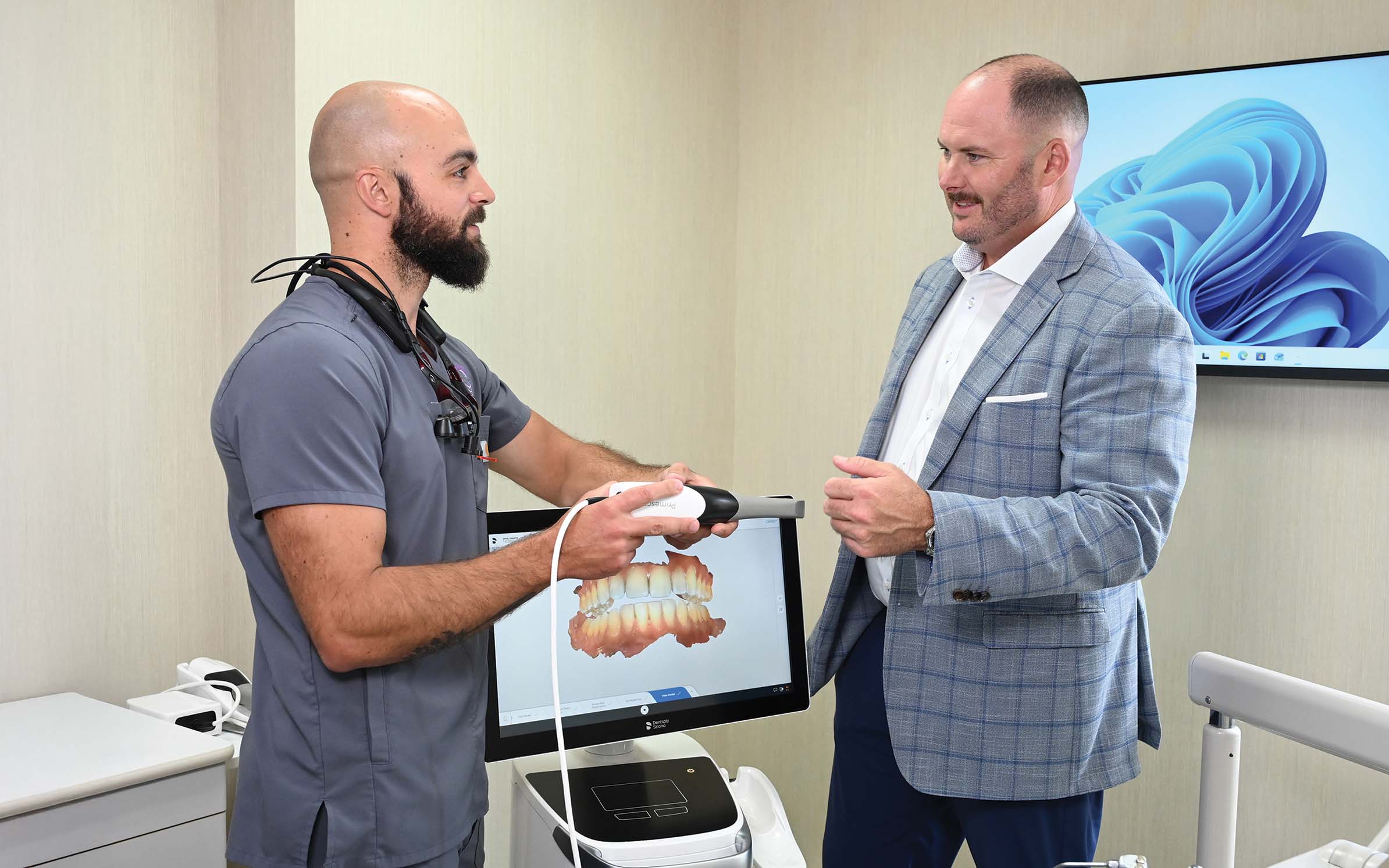
David Cushman of Genesee Regional Bank (right) meets with client Dr. Frank L. Sapere of Webster Dental Group. | Photo: John Smillie
September 01, 2026 / By Beth Mattson-Teig
Healthcare practice financing is no longer a niche play. It’s an opportunity to build deep relationships in a fast-growing, low-risk industry.
Healthcare is one of the most resilient sectors of the economy: Last year, national healthcare was projected to top $5.7 trillion. On a local level, community banks are seeing demand for capital from medical and dental practices to fund new startups, acquisitions, consolidation, expansion and new equipment.
Genesee Regional Bank in Rochester, New York, has been capitalizing on that wave of growth for the past decade.
Since launching its formal healthcare financing program in late 2016, the $1.3 billion-asset community bank’s healthcare client list has grown roughly tenfold. It now has more than 160 relationships with medical and dental clients that include about $12 million in deposit balances and $85 million in outstanding loans.
“These professionals like to have everything under one roof,” says David Cushman, group vice president and professional practice team leader for Genesee Regional Bank. If a professional chooses to finance their acquisition with a bank, they likely also want their business and personal accounts, payment processing and other services with the same bank.
Growth across the medical sector is due to an aging population and a broader trend to decentralize care away from traditional large hospital campuses. “There’s a lot of movement in the industry right now,” says Tom Kutyla, senior vice president and commercial lending division manager of the Columbia, South Carolina, branch at $28.2 billion-asset United Community Banks Inc. in Greenville, South Carolina.
In South Carolina, for example, healthcare activity is being fueled by increased consolidation and a bigger push for independent and clinical autonomy across the state. Roughly 12% of all practices in South Carolina are independent, which means 88% are hospital-owned or hospital-oriented employees. Kutyla sees this as a great opportunity for the private professional practice segment to grow.
A demand for relationship banking
Many community banks also see an opportunity for relationship lenders to move into a sector that has traditionally been dominated by large national banks that operate on transactional models.
Relationships have become a key differentiator for community banks in a highly competitive lending sector like dental. Because dental practices tend to have the lowest default rates, and loan production tends to be less complex than medical practices, some banks are aggressive in pursuing dental loans as loss leaders to get relationships and improve their balance sheets.
SouthState Bank in Winter Haven, Florida, works under a relationship model and assigns one banker to each medical, dental or veterinarian customer to handle all their banking needs, both business and personal.
“That banker is their go-to person, their one-stop shop, and that’s what doctors want,” says Ben Collier, director of practice finance for the $67.2 billion-asset community bank. “They want convenience.”
The importance of understanding enterprise financing
One of the hurdles for community banks hoping to move into the complex medical and dental sector is the need to develop expertise and cultivate relationships. A key distinction of healthcare financing is that most banks lend on enterprise value, meaning the bank accepts the goodwill or intangible value of privately owned dental, medical and veterinary practices as collateral.
That enterprise value approach allows SouthState Bank to lend on extended terms of up to 10 years versus a three- to five-year term without enterprise value.
Collier says starting and growing a healthcare financing platform requires two things: an internal expert to drive sales, and alignment on the credit side. The internal experts need to understand the industry and be able to help the bank design the right products, build relationships and market to medical professionals. The credit team has to be willing to lend on goodwill and to create an enterprise value lending policy in the small-business sector of healthcare.
“To a bank that’s never done that before, that may be a very scary thing to do,” says Collier. “But it’s hard to win in this space if you’re not able to lend upon the enterprise value of those practices, because that’s what most of your competitors are doing.” He adds that the relationship between the credit side and the internal experts is important, so they can learn from one another.
Understanding practitioners’ finances also helps when banks are underwriting practice loans. For example, Genesee Regional Bank did a deep dive about two years ago to better understand the personal debt and income-based repayment plans that many doctors have with student loan companies. Understanding how student loan companies calculate the income-based repayment helps the community bank to better forecast its own cash flow analysis.
“The biggest challenge for the banks is receiving timely information and analyzing that information,” says Kutyla. Having current data, rather than waiting to see financials 30 to 45 days after month’s end, helps bankers anticipate financial needs so the bank can be proactive in the relationship and not reactive, he adds.
Trusted advisors for the sector
$5.7T
Projected healthcare spending in the U.S. in 2025
Source: Centers for Medicare & Medicaid Services
Most professional practice clients are looking for a banker who can also be a trusted advisor.
“They certainly want competitive rates, but what’s more important to 98% of them is having somebody who will pick up a call at 7 a.m. or will talk to them when they’re done with work at 5:30 p.m.,” says Cushman.
He notes that healthcare practice clients aren’t going to pay 2% higher than the low rate at a national bank, but many are willing to pay an extra quarter to a half point higher rate, because they do see the value in the relationship and accessibility to a trusted advisor.
In addition to building relationships and working as a team with CPAs, attorneys and financial advisors, Kutyla has made a point to form partnerships with a practice’s management service organization (MSO).
“We want to be the first phone call if they’re thinking about doing something,” says Kutyla. “So, we partner with the other strategic partners within the healthcare sectors.”
The MSOs specialize in revenue cycle management, and they are on the front end of what’s going on in the industry in terms of regulatory compliance and changes in insurance processes. “We have a very focused approach and a team environment when we go into a new practice, or an existing one, to help them see where the risk is, to mitigate the risk and help the practice achieve their desired goal,” says Kutyla.
Whether it’s a dental, medical or veterinary practice, it is important to understand who the key advisors are in the industry, agrees Cushman. Who are the dental brokers in your market that are doing a lot of the acquisition business? What are the local professional associations, and what types of events or sponsorship opportunities could your bank participate in to promote its brand?
“Having the right credit policy and everybody on board, along with the right vendors and partners in that specific market,” Cushman says, “is key to building a successful program.”
Healthcare practice banking requires banks to meet specialized needs
Some community banks are creating credit policies, products and bundled services to better appeal to medical and dental clients. For example, Genesee Regional Bank’s professional practice credit policy allows the Rochester, New York, community bank to finance 100% of the purchase price on the acquisition of a practice, plus provide additional working capital and equipment needs.
To better compete with equipment lenders, Genesee Regional Bank also developed an equipment-only loan program that features a streamlined two-page application and a specific set of closing documents that can turn a medical equipment loan around in as little as a few hours. Additionally, the bank offers bundled services and home equity discounts designed for professional practice clients.
“We really come at clients from all different angles to deepen relationships,” says David Cushman, vice president and professional practice team leader.
SouthState Bank in Winter Haven, Florida, offers treasury management and merchant services products that are specific to the healthcare industry. It also works with vendor partners to offer merchant services that interface with healthcare practice software.
Staying in tune with the unique needs of medical and dental practices helps community bankers provide the products and services that will help position their customers for success. Some healthcare practices are leaning into automated payment options, such as text-to-pay options, more so than other industries. Healthcare clients are also expressing more interest in fraud prevention tools.
Beth Mattson-Teig is a writer in Minnesota.
Subscribe now
Sign up for the Independent Banker newsletter to receive twice-monthly emails about new issues and must-read content you might have missed.
Sponsored Content

Featured Webinars


Join ICBA Community
Interested in discussing this and other topics? Network with and learn from your peers with the app designed for community bankers.
Related Articles

Community Banks Win Big with Sports Sponsorships
MarketingGrowth

How Community Banks Can Navigate Today's Risk Landscape
CybersecurityCompliance & Risk

Subscribe Today
Sign up for Independent Banker eNews to receive twice-monthly emails that alert you when a new issue drops and highlight must-read content you might have missed.
News Watch Today

Join the Conversation with ICBA Community
ICBA Community is an online platform led by community bankers to foster connections, collaborations, and discussions on industry news, best practices, and regulations, while promoting networking, mentorship, and member feedback to guide future initiatives.
Join the Community Example Text